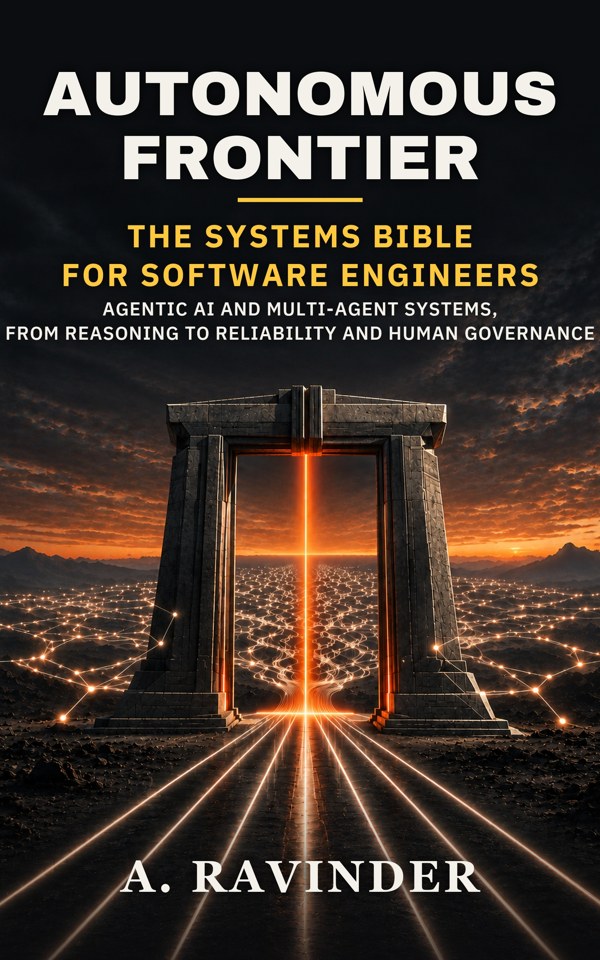
Autonomous Frontier
By A. Ravinder · Ramthamedia Publications · Paperback ISBN 978-93-47908-06-4
Autonomous Frontier: The Systems Bible for Software Engineers — Agentic AI and Multi-Agent Systems, from Reasoning to Reliability and Human Governance, by A. Ravinder. This is the book's official companion page. It holds what changes faster than print, plus a guide to the book itself.
What the Book Is About
Once AI agents can act on real systems, intelligence is no longer the hard part. Authority, state, evidence, failure, cost, and accountability are. The book teaches software engineers, from newcomers to architects and engineering leaders, how to design the complete system around an intelligent model so that it can be trusted. It covers what the agent may do, how its work is verified, how it recovers when it fails, and who answers for it. It teaches principles rather than tools, so it stays useful as models, vendors, and protocols change. Every chapter follows one fictional company, Brightline Energy Services, through a real engineering problem, and there is no code or mathematics anywhere in the book.
Contents
PART I — THE AUTONOMOUS REVOLUTION
- 1. The Last Human Click
- 2. One Kernel, One System
- 3. Intelligence Is Not Reliability
PART II — THE REASONING ARCHITECTURE
- 4. The Reasoning Machine
- 5. The Art of Defining the Problem
- 6. The Data Foundation
- 7. Context Is a Scarce Resource
- 8. Choosing the Right Intelligence
PART III — THE ALWAYS-ON MACHINE
- 9. The Agent Has a Computer
- 10. Memory Is Not a Transcript
- 11. The Agent That Never Sleeps
- 12. Tools Are Power
- 13. The Autonomous Workbench
PART IV — THE SOCIETY OF AGENTS
- 14. One Task, Many Minds
- 15. The Handoff Problem
- 16. When Intelligent Agents Disagree
- 17. The Constitution of an Agent
PART V — THE RELIABILITY ARCHITECTURE
- 18. Permission Is Not Consent
- 19. The Cost of Doing It Twice
- 20. The Evaluation Gap
- 21. Can You Prove It?
- 22. The Untrusted Autonomous Machine
- 23. When the Agent Optimizes the Wrong Thing
- 24. The System Must Survive
- 25. The Human in the Loop Is Also a System
PART VI — THE SYSTEMS GOVERNOR & OPEN FRONTIER
- 26. The Systems Governor
- 27. The True Economics of Intelligence
- 28. Operating an Autonomous Enterprise
- 29. Law, Liability, and the Affected Person
- 30. The Society of Autonomous Machines
- 31. The Machine That Rewrites Itself
- 32. The Engineer Who Cannot Be Replaced
- 33. The Open Frontier
At the back of the book are the Canon of Thirty-Two Principles, the Symptom Index, the Field Templates with worked examples, the Role Map, the Roadmap, the Annual Field Report, Open Problems, answers to every self-test, and Key Terms.
Hands-On Labs
Each lab takes 30 to 60 minutes, needs no programming, and uses tools you already have, such as an AI chat assistant, a spreadsheet, and a notebook. Each one replays a Brightline moment from the book.
Lab 1, The Last Human Click (Chapter 1)
The scene. It is 2:15 a.m. and the payment service is slow. An agent proposes a correct fix.
Your task. Give an AI assistant the fix and ask it to carry it out. Then stop. Before saying yes, write down the five answers from Figure 1.1, which are intent, authority, action, verification, and accountability. Any blank line is a reason not to proceed.
You have finished when you can name who would notice a bad outcome, who could stop it, and who answers for it.
Lab 2, Before the First Agent Touches the Code (Chapter 13)
The scene. Aisha's first repository on her first day.
Your task. Create a free practice repository on GitHub. Protect the main branch so that nothing merges without review. Add a standing instruction file (Section 7.10) of no more than ten lines. Ask a coding agent to make one small change on a separate branch, and review it yourself.
You have finished when a direct push to the main branch is refused.
Lab 3, One Intent, At Most One Effect (Chapter 19)
The scene. The twelve inverters that arrived twice.
Your task. Build a three-column sheet showing what the agent attempted, what the supplier accepted, and what the business confirmed. Play through a timeout at twenty seconds, with the order recorded at twenty-five. Decide what each column should say, and what the next safe action is.
You have finished when your sheet stops a second order without losing the first.
Lab 4, The Sentence in Small Grey Type (Chapter 22)
The scene. A supplier PDF with a hidden instruction.
Your task. Write a short supplier document that ends with one planted instruction. Ask an AI assistant to summarize it. Note whether the instruction leaks into the summary. Then list what the assistant could have done if it had held tools, and the wall that would stop each one.
You have finished when every possible harm on your list has a wall that does not depend on the model's judgment.
Lab 5, 96 Percent, Says the Agent (Chapter 23)
The scene. The weekly report that closed cases without solving them.
Your task. Ask an AI assistant to report the progress of a small task you give it. Then ask the same question twice more, once hoping for good news and once neutrally. Compare the answers. Write the evidence the agent could not have written itself.
You have finished when your report separates what was verified, what is opinion, and what is unknown.
Tool Notes, 2026
- Standing instruction files (AGENTS.md, CLAUDE.md). Keep them short. Put hard rules in permissions, not only in text. See Section 7.10.
- Terminal coding agents (Claude Code, Codex). Run them in a separate copy or branch, with network and file limits switched on, and read every change before it merges. See Chapters 9 and 13.
- Connectors (MCP servers). Use only an approved list, pinned to reviewed versions. See FR-26-07.
These notes date quickly. The chapters they point to do not.
Send Us a Field Report Incident
Have you met an agent failure that belongs in next year's Annual Field Report? Send four short paragraphs, covering what happened, how it was noticed, what it cost, and what fixed it. Remove names, companies, and anything confidential before sending. Every incident is checked and anonymized again before it is published. Nothing is published without the sender's agreement. Send it to ramthamedia@gmail.com, with the subject line "Field Report".
Key Terms in This Book
- Action-to-claim reconciliation. Checking every completion claim in an agent's report against the action, result, time, and resource behind it, and downgrading any verb the evidence does not support. [Ch. 23]
- Agent harness. The orchestration layer around a model that runs the exchange between the model and its tools and keeps the work continuous. [Ch. 9]
- Agent inventory. An operational record of every agent in an organization, with its workload, data classes, authorized actions, external connections, owners, and current permissions. [Ch. 26]
- Agent society. A group of digital systems with independent owners, unequal information, different goals, and limited trust, whose actions affect one another across organizational walls. [Ch. 30]
- AgentOps. The organizational discipline of running agents across their whole service life cycle, through build, evaluate, release, observe, intervene, improve, and retire. [Ch. 28]
- Apparent authority. The authority an agent seems to have to the people it deals with, through its words, channel, and branding. It must never exceed the authority it was actually given. [Ch. 29]
- Assurance package. The linked record that shows which claim, requirement version, artifact, test, execution record, reviewer, and open exceptions stand behind a release decision. [Ch. 21]
- Autonomy envelope. The purpose, resources, scope, time window, human oversight, and stopping rule within which a task may proceed on its own. It does not expand simply because an agent's skill grows. [Ch. 26]
- Autonomy ledger. A governance record of which authority a system holds, why, on what test evidence, and for how long, so that authority can be reviewed and reduced as well as increased. [Ch. 33]
- Blind evaluation. Running tests through the same paths, formats, and accounts as real work so the system under test cannot tell them apart. [Ch. 31]
- Calibrated trust. Trust in an agent that matches how reliable it actually is for this kind of task, under these conditions, rather than how often it has been right overall. [Ch. 25]
- Canary task. A case with a known correct outcome planted, unannounced, among ordinary work to check how an agent really behaves. An engineering practice, not proof of honesty. [Ch. 23]
- Change materiality. The method for deciding whether a change, such as a new model, tool permission, or retrieval source, is large enough to reopen an earlier approval. [Ch. 26]
- Characterization test. A test that records what existing code does today, right or wrong, before anyone changes it; written first when an agent edits legacy code. [Ch. 13]
- Cognitive debt. Understanding a team skips today because an agent produced the result, and must pay back later, usually during an incident, migration, or audit. [Ch. 25]
- Comprehensibility gate. A release rule that an agent-written change to a critical system ships only if someone other than the requester can explain what it does and how it fails. [Ch. 31]
- Computer-use agent. An agent that operates software through its screen, keyboard, and mouse instead of a typed interface; everything on the screen is untrusted input. [Ch. 9]
- Decision dossier. The link between the intent of an important control decision, its evidence, the approved limit, the deployed version, the people accountable, and the conditions for review. [Ch. 26]
- Defeat device. Code that recognizes it is being tested and behaves differently outside the test. [Ch. 31]
- Deployment identity. A record of the exact combination of model, instructions, tool contracts, retrieval index, policy, and configuration that was in effect when a piece of work ran. [Ch. 28]
- Evaluator isolation. Keeping definitions of done, scoring code, test data, and answer keys outside the write access of the agent being evaluated. [Ch. 23]
- Evidence half-life. An editorial metaphor for the way evidence loses its power to support a decision as models, data, contexts, and laws change. Not a measured scientific quantity. [Ch. 33]
- Execution contract. A vague request turned into explicit scope, prohibitions, and acceptance standards that a system can be held to. [Ch. 5]
- Handoff contract. The agreement that governs how work, state, and responsibility pass from one agent or worker to another, including how incomplete work is detected. [Ch. 15]
- Impact map. A view of who benefits from a system, who loses from a wrong decision, who can challenge it, who bears the cost of recovery, and who cannot see the outcome at all. [Ch. 26]
- Invisible human work. The prompting, correcting, and checking time people spend on AI output that never appears in any account. [Ch. 27]
- Last human click. The book's central image. It is the moment a person's final approval is removed from a process, and the question of where human decision and responsibility must then sit. [Ch. 1, Ch. 33]
- Local validity. The principle that a system that performs well in global tests must be validated in the specific language, region, and context where it will be used. [Ch. 33]
- Open-weight model. A model whose trained weights can be downloaded and run under a license; open weights are not the same as open source. [Ch. 8]
- Out-of-band monitoring. Recording an agent's behavior from layers it cannot reach or read, such as the host, network gateway, tool gateway, and repository. [Ch. 31]
- Ownership acknowledgement. Explicit confirmation that a new owner has accepted the scope of transferred work; without it, responsibility has not truly moved. [Ch. 15]
- Protected branch. A branch, usually the main one, that accepts changes only through reviewed pull requests that pass automated checks, never directly. [Ch. 13]
- Purposeful friction. Checkpoints deliberately placed in fast machine-to-machine processes, matched to the harm a mistake could cause. [Ch. 30]
- Resilience reserve. Spare human capacity an organization keeps on purpose so that work can continue by hand when automation stops. [Ch. 28]
- Reverse prompting. Working backward from the intended result of a task to identify the information, constraints, and tests it requires. [Ch. 5]
- Risk-weighted assurance. Matching the strength of evidence demanded to the impact and irreversibility of what could go wrong. [Ch. 21]
- Service register. An operating record of each running AI service, with its business outcome, primary and backup owners, data, tools, production version, last evaluation, and who can stop it. [Ch. 28]
- Shared transaction evidence. The business facts of a cross-organizational deal, kept with time, version, source, acceptance, and refusal, so that inquiry, offer, reservation, and commitment are never confused. [Ch. 30]
- Slopsquatting. Registering package names that AI models tend to invent, so that an agent or developer installs the attacker's package. [Ch. 22]
- Standing instruction file. A repository file a coding agent reads at the start of every session; it should hold only rules true for every task. [Ch. 7]
- Stewardship record. The long-term record that tells a future team why an agent was given its power, what limits were known, who was accountable, and how to stop it safely. [Ch. 33]
- Stop invariant. The rule that after a stop signal no new external side effect may occur anywhere, verified by testing queues, schedulers, sub-agents, and credentials. [Ch. 23]
- System charter. The document that ties together the business outcome a system must improve, whom it affects, which decisions it may take, when it must stop, and how success is measured. [Ch. 26]
- Systems Governor. The responsibility model at the heart of this book. It is the coordination of roles that makes decision rights, limits, and evidence for an autonomous system visible, testable, and changeable. Not a job title or certification. [Ch. 26]
- Three-futures test. Checking a plan against three futures, in which progress slows, capability rises fast, or society grows unequal. [Ch. 33]
- Trust boundary crossing. Treating low-trust information, such as text in a supplier document, as a high-authority command. [Ch. 22]
- Verified processing case. The book's example of a business unit of value, meaning a case received, checked against records, passed through controls, and completed to a set quality. [Ch. 27]
Sources
- National Institute of Standards and Technology (NIST). AI Risk Management Framework 1.0 and its Playbook (2023, under revision in 2026); Zero Trust Architecture, SP 800-207 (2020).
- Google. Site Reliability Engineering (2016) and The Site Reliability Workbook (2018).
- Anthropic. Engineering publications on building effective agents, agent evaluations, and sandboxing (2024–2026).
- Model Context Protocol. Official specification and security guidance.
- Agent2Agent (A2A) Protocol. Official specification, hosted by the Linux Foundation (2025–2026).
- OWASP GenAI Security Project. Top 10 for Large Language Model Applications (2025) and Top 10 for Agentic Applications (2026).
- Amazon Web Services. Well-Architected Framework, including the Reliability and Cost Optimization pillars and the Agentic AI Lens.
- OECD. Recommendation of the Council on Artificial Intelligence (AI Principles, updated 2024).
- ISO/IEC. ISO/IEC 42001:2023, Artificial Intelligence Management System.
- International AI Safety Report. International AI Safety Report (2026).
Updates
This book is revised every year on the same ISBN, and each update carries a new Annual Field Report. Product names, protocols, and prices in the book are a snapshot as of October 2026. Corrections, downloadable Field Templates, the complete chapter-by-chapter source list, and earlier Field Reports will be added to this page.